Love built on beauty, soon as beauty, dies.
-John Donne
Love & Beauty
The above quote by John Donne is a pretty good observation.
It is what melodramas are made of. 🙂
As human beings we do love beauty, physical beauty. We admire it as it is a step forward toward perfection.
Apparently there was a brain scan study made which found that when a person sees a beautiful thing, a good design or an attractive object, a part of the brain, the motor cerebellum, which control hand movement is triggered.
So reaching for something beautiful is really quite natural. No wonder most museums and shops have the ‘Don’t Touch’ signs! 🙂
What happens when that something beautiful is no longer than pretty, does the motor cerebellum then tells the hands to drop it?!!!
I love primroses. They are so hardy. They grow and flower any time of the year even in poor soil.
Just love them.
They are great for your window boxes as well as borders. And they are also beautiful as an indoor plant, that sits comfortably at the window sill. Primroses may need a slight protection during the cold weather, in winter specially when there is snow on the ground.
Primroses start to show off their cute colourful blossoms at the inset of spring. While they are in flowers, they should be fed fortnightly with a liquid fertiliser.
Welcome, pale primrose, starting up between
Dead matted leaves of oak and ash, that strew
The every lawn, the wood, and spinney through,
‘Mid creeping moss and ivy’s darker green!
How much thy presence beautifies the ground!
How sweet thy modest, unaffected pride
Glows on the sunny bank and wood’s warm side!
And where thy fairy flowers in groups are found
The schoolboy roams enchantedly along,
Plucking the fairest with a rude delight,
While the meek shepherd stops his simple song,
To gaze a moment on the pleasing sight,
O’erjoyed to see the flowers that truly bring
The welcome news of sweet returning Spring.
~ John Clare
……………………………………………………………………………………………………………………………
The Primrose
Upon this Primrose hill,
Where, if Heav’n would distil
A shower of rain, each several drop might go
To his own primrose, and grow manna so;
And where their form and their infinity
Make a terrestrial Galaxy,
As the small stars do in the sky:
I walk to find a true Love; and I see
That ’tis not a mere woman that is she,
But must or more or less than woman be.
Yet know I not which flower
I wish; a six, or four;
For should my true-Love less than woman be
She were scarce any thing; and then, should she
Be more than woman she would get above All thought of sex, and think to move
My heart to study her, and not to love;
Both these were monsters; since there must reside
Falsehood in woman, I could more abide
She were by art than Nature falsified.
Live primrose then, and thrive
With thy true number five;
And woman, whom this flower doth represent,
With this mysterious number be content;
Ten is the farthest number; if half ten
Belong unto each woman, then
Each woman may take half us men;
Or if this will not serve their turn, since all
Numbers are odd or even, and they fall
First into this, five, woman may take us all.
John Donne
—————–
Did you know?
John Donne was the very first writer to use the word “sex” referring to its present meaning of copulation; the poem was The Primrose. See above.
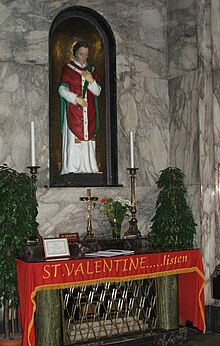
The origin of St Valentine is rather obscure. He was supposed to have been martyred on 14 February.
St Valentine could be any of these martyrs or could be one and the same; the bishop at Terni whose feast day falls due on 14 February shares the same supposed “acts” with Marius and Martha, Persians couple who were martyred in Rome.
There was no legend about gifting girlfriends or boyfriends on February 14. Apparently, the celebration may have been created to super-imposed on some pagan rituals that occur on that particular day.
Legend has it on the middle part of February, It is also thought that birds begin to pair up on that day.
Below is a poem, an ode to St Valentine by John Donne. Let’s immerse ourselves into this beautiful poem and feel the love…. 😉
AN EPITHALAMION, OR MARRIAGE SONG
ON THE LADY ELIZABETH AND COUNT
PALATINE BEING MARRIED ON ST. VALENTINE’S DAY
by John Donne
HAIL Bishop Valentine, whose day this is ;
All the air is thy diocese,
And all the chirping choristers
And other birds are thy parishioners ;
Thou marriest every year
The lyric lark, and the grave whispering dove,
The sparrow that neglects his life for love,
The household bird with the red stomacher ;
Thou makest the blackbird speed as soon,
As doth the goldfinch, or the halcyon ;
The husband cock looks out, and straight is sped,
And meets his wife, which brings her feather-bed.
This day more cheerfully than ever shine ;
This day, which might enflame thyself, old Valentine.
II.
Till now, thou warmd’st with multiplying loves
Two larks, two sparrows, or two doves ;
All that is nothing unto this ;
For thou this day couplest two phoenixes ;
Thou makst a taper see
What the sun never saw, and what the ark
—Which was of fouls and beasts the cage and park—
Did not contain, one bed contains, through thee ;
Two phoenixes, whose joined breasts
Are unto one another mutual nests,
Where motion kindles such fires as shall give
Young phoenixes, and yet the old shall live ;
Whose love and courage never shall decline,
But make the whole year through, thy day, O Valentine.
III.
Up then, fair phoenix bride, frustrate the sun ;
Thyself from thine affection
Takest warmth enough, and from thine eye
All lesser birds will take their jollity.
Up, up, fair bride, and call
Thy stars from out their several boxes, take
Thy rubies, pearls, and diamonds forth, and make
Thyself a constellation of them all ;
And by their blazing signify
That a great princess falls, but doth not die.
Be thou a new star, that to us portends
Ends of much wonder ; and be thou those ends.
Since thou dost this day in new glory shine,
May all men date records from this day, Valentine.
IV.
Come forth, come forth, and as one glorious flame
Meeting another grows the same,
So meet thy Frederick, and so
To an inseparable union go,
Since separation
Falls not on such things as are infinite,
Nor things, which are but one, can disunite.
You’re twice inseparable, great, and one ;
Go then to where the bishop stays,
To make you one, his way, which divers ways
Must be effected ; and when all is past,
And that you’re one, by hearts and hands made fast,
You two have one way left, yourselves to entwine,
Besides this bishop’s knot, of Bishop Valentine.
V.
But O, what ails the sun, that here he stays,
Longer to-day than other days ?
Stays he new light from these to get ?
And finding here such stars, is loth to set ?
And why do you two walk,
So slowly paced in this procession ?
Is all your care but to be look’d upon,
And be to others spectacle, and talk ?
The feast with gluttonous delays
Is eaten, and too long their meat they praise ;
The masquers come late, and I think, will stay,
Like fairies, till the cock crow them away.
Alas ! did not antiquity assign
A night as well as day, to thee, old Valentine ?
VI.
They did, and night is come ; and yet we see
Formalities retarding thee.
What mean these ladies, which—as though
They were to take a clock in pieces—go
So nicely about the bride ?
A bride, before a “ Good-night” could be said,
Should vanish from her clothes into her bed,
As souls from bodies steal, and are not spied.
But now she’s laid ; what though she be ?
Yet there are more delays, for where is he ?
He comes and passeth through sphere after sphere ;
First her sheets, then her arms, then anywhere.
Let not this day, then, but this night be thine ;
Thy day was but the eve to this, O Valentine.
VII.
Here lies a she sun, and a he moon there ;
She gives the best light to his sphere ;
Or each is both, and all, and so
They unto one another nothing owe ;
And yet they do, but are
So just and rich in that coin which they pay,
That neither would, nor needs forbear, nor stay ;
Neither desires to be spared nor to spare.
They quickly pay their debt, and then
Take no acquittances, but pay again ;
They pay, they give, they lend, and so let fall
No such occasion to be liberal.
More truth, more courage in these two do shine,
Than all thy turtles have and sparrows, Valentine.
VIII.
And by this act these two phoenixes
Nature again restorèd is ;
For since these two are two no more,
There’s but one phoenix still, as was before.
Rest now at last, and we—
As satyrs watch the sun’s uprise—will stay
Waiting when your eyes opened let out day,
Only desired because your face we see.
Others near you shall whispering speak,
And wagers lay, at which side day will break,
And win by observing, then, whose hand it is
That opens first a curtain, hers or his :
This will be tried to-morrow after nine,
Till which hour, we thy day enlarge, O Valentine.
Source:
Donne, John. Poems of John Donne. vol I.
E. K. Chambers, ed.
London: Lawrence & Bullen, 1896. 83-87.