Tag: Myths and Legends

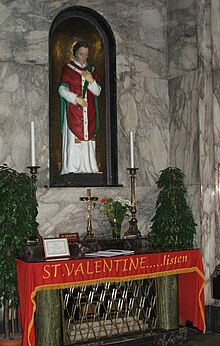
St Valentine

The origin of St Valentine is rather obscure. He was supposed to have been martyred on 14 February.

St Valentine could be any of these martyrs or could be one and the same; the bishop at Terni whose feast day falls due on 14 February shares the same supposed “acts” with Marius and Martha, Persians couple who were martyred in Rome.

There was no legend about gifting girlfriends or boyfriends on February 14. Apparently, the celebration may have been created to super-imposed on some pagan rituals that occur on that particular day.

Legend has it on the middle part of February, It is also thought that birds begin to pair up on that day.

Below is a poem, an ode to St Valentine by John Donne. Let’s immerse ourselves into this beautiful poem and feel the love…. 😉

AN EPITHALAMION, OR MARRIAGE SONG
ON THE LADY ELIZABETH AND COUNT
PALATINE BEING MARRIED ON ST. VALENTINE’S DAY

by John Donne

HAIL Bishop Valentine, whose day this is ;
All the air is thy diocese,
And all the chirping choristers
And other birds are thy parishioners ;
Thou marriest every year
The lyric lark, and the grave whispering dove,
The sparrow that neglects his life for love,
The household bird with the red stomacher ;
Thou makest the blackbird speed as soon,
As doth the goldfinch, or the halcyon ;
The husband cock looks out, and straight is sped,
And meets his wife, which brings her feather-bed.
This day more cheerfully than ever shine ;
This day, which might enflame thyself, old Valentine.

II.

Till now, thou warmd’st with multiplying loves
Two larks, two sparrows, or two doves ;
All that is nothing unto this ;
For thou this day couplest two phoenixes ;
Thou makst a taper see
What the sun never saw, and what the ark
—Which was of fouls and beasts the cage and park—
Did not contain, one bed contains, through thee ;
Two phoenixes, whose joined breasts
Are unto one another mutual nests,
Where motion kindles such fires as shall give
Young phoenixes, and yet the old shall live ;
Whose love and courage never shall decline,
But make the whole year through, thy day, O Valentine.

III.

Up then, fair phoenix bride, frustrate the sun ;
Thyself from thine affection
Takest warmth enough, and from thine eye
All lesser birds will take their jollity.
Up, up, fair bride, and call
Thy stars from out their several boxes, take
Thy rubies, pearls, and diamonds forth, and make
Thyself a constellation of them all ;
And by their blazing signify
That a great princess falls, but doth not die.
Be thou a new star, that to us portends
Ends of much wonder ; and be thou those ends.
Since thou dost this day in new glory shine,
May all men date records from this day, Valentine.

IV.

Come forth, come forth, and as one glorious flame
Meeting another grows the same,
So meet thy Frederick, and so
To an inseparable union go,
Since separation
Falls not on such things as are infinite,
Nor things, which are but one, can disunite.
You’re twice inseparable, great, and one ;
Go then to where the bishop stays,
To make you one, his way, which divers ways
Must be effected ; and when all is past,
And that you’re one, by hearts and hands made fast,
You two have one way left, yourselves to entwine,
Besides this bishop’s knot, of Bishop Valentine.

V.

But O, what ails the sun, that here he stays,
Longer to-day than other days ?
Stays he new light from these to get ?
And finding here such stars, is loth to set ?
And why do you two walk,
So slowly paced in this procession ?
Is all your care but to be look’d upon,
And be to others spectacle, and talk ?
The feast with gluttonous delays
Is eaten, and too long their meat they praise ;
The masquers come late, and I think, will stay,
Like fairies, till the cock crow them away.
Alas ! did not antiquity assign
A night as well as day, to thee, old Valentine ?

VI.

They did, and night is come ; and yet we see
Formalities retarding thee.
What mean these ladies, which—as though
They were to take a clock in pieces—go
So nicely about the bride ?
A bride, before a “ Good-night” could be said,
Should vanish from her clothes into her bed,
As souls from bodies steal, and are not spied.
But now she’s laid ; what though she be ?
Yet there are more delays, for where is he ?
He comes and passeth through sphere after sphere ;
First her sheets, then her arms, then anywhere.
Let not this day, then, but this night be thine ;
Thy day was but the eve to this, O Valentine.

VII.

Here lies a she sun, and a he moon there ;
She gives the best light to his sphere ;
Or each is both, and all, and so
They unto one another nothing owe ;
And yet they do, but are
So just and rich in that coin which they pay,
That neither would, nor needs forbear, nor stay ;
Neither desires to be spared nor to spare.
They quickly pay their debt, and then
Take no acquittances, but pay again ;
They pay, they give, they lend, and so let fall
No such occasion to be liberal.
More truth, more courage in these two do shine,
Than all thy turtles have and sparrows, Valentine.

VIII.

And by this act these two phoenixes
Nature again restorèd is ;
For since these two are two no more,
There’s but one phoenix still, as was before.
Rest now at last, and we—
As satyrs watch the sun’s uprise—will stay
Waiting when your eyes opened let out day,
Only desired because your face we see.
Others near you shall whispering speak,
And wagers lay, at which side day will break,
And win by observing, then, whose hand it is
That opens first a curtain, hers or his :
This will be tried to-morrow after nine,
Till which hour, we thy day enlarge, O Valentine.

Source:
Donne, John. Poems of John Donne. vol I.
E. K. Chambers, ed.
London: Lawrence & Bullen, 1896. 83-87.

The Legend of the Pineapple (Alamat Ng Pinya)

Legend
Filipino Legend
Fruit Legend

The Legend of the Pineapple (Alamat Ng Pinya)


Pineapple grows abundantly in the Philippines and as popular as the banana.

This is a Filipino legend about the pineapple based on a book of legends by F. Landa Jocano.

Anyway our legend goes…..

Once upon a time, in the town of Arevalo in Iloilo province, there lived a widow named Kerok. She had a beautiful daughter whom she spoiled to no end. The daughter was called Pinay. Whatever Pinay wanted, she got. Thus, Pinay grew up into a very lazy, spoiled girl.

One day Kerok got sick. She asked her daughter to do the cooking for once. Young Pinay with much displeasure washed a handful of rice and placed it into a pot to cook. She then run off to play. When Pinay returned, she found that the rice had burnt. Kerok was annoyed and yet she comforted herself by the thought that at least Pinay did do what she was told.

Kerok continued to be bedridden which forced the resentful Pinay to do the housework. She would ask her mother for the minutest, most inconsequential things. Poor Kerok could not get a moment’s peace or a proper rest.

One evening, whilst cooking in the kitchen, Pinay noticed that the ladle was missing. Pinay did try to look for the ladle everywhere but she could not find it so she went to her mother to demand the whereabout of the ladle.

Kerok was at the end of her tether with Pinay. She cried out: “I wish you had many eyes so that you could find at once what you are looking for.” Pinay, rather shameful, did not answer and just went downstairs to look for the ladle once more.

Night fell. Kerok waited and waited for Pinay but she did not come up. She was not in the kitchen either. Kerok called out but no one answered.

After a few more days Kerok got better. Still thinking that Pinay was probably sulking somewhere and would not come home, Kerok went to her neighbours to ask them if they had seen Pinay. No one had seen Pinay. Kerok was inconsolable with grief.

One day while sweeping the yard, Kerok saw an unusual plant growing near a wall. The leaves were slender and pointed. She watered the plant everyday for something to do to alleviate her sorrow and worry about the missing Pinay. After a few days, the plant started to bear a fruit with many holes resembling eyes.

She remembered Pinay and realised that the plant must be her daughter. She cried and cried until she heard the plant talking. “I am Pinay, your daughter, who the gods transformed into a plant when you wished it. You may weep and weep, but I can never again return to you. Take the fruit however and eat it. This way you will remember me.”

Ever since, the plant was called Pinya in honour of Pinay – the girl who was turned into a plant that bears fruit with many eyes.

Moral: Be careful of what you wish for!!!

King Arthur and the Knights of the Round Table

Legend

King Arthur and the Knights of the Round Table


The legend of King Arthur and his knights has been debated for years. Some say it happened, some say it is a word by mouth fiction. One thing though, the legend has stood the test of time. It has continued to be a subject of films and television series. It has continued to gather admirers from one generation to the next.

We know King Arthur and his queen, Guinevere, but we are less familiar of the brave and valiant knights of the round table. The knights promoted chivalry at the highest order which is legendary.

There are at least 150 knights whose primary quest was to find the Holy Grail. The knights’ round table symbolizes that all the knights are equal.

Here are at least the 10 most popular knights:

Sir Benevere was a very skilled warrior but lost one of his hands in a battle. He was the one who returned the Excalibur to the Lady of the Lake.

Sir Bors was a son of a king who bore the same name. Sir Bors joined the crusade to the Holy Land; he was one of the knights who found the Holy Grail. Sir Bors died during the crusade.

Sir Caradoc was one of King Arthur’s closest aide. He was the son of Eliavres, the wizard, who was the founder of the Kingdom of Gwent.

Sir Galahad joined King Arthur and the other knights for the quest of the Holy Grail.

Sir Gawain was a nephew of King Arthur. Sir Gawain has his own legend with the Green Knight.

Sir Kay was one of the first knights of the round table.

Sir Lancelot was once King Arthur’s closest friends but he got involved with Guinevere.

Sir Percival also went with King Arthur on quest for the Holy Grail.

Sir Sagramore was a Hungarian prince who came to England to be a knight of the Round Table.

Sir Tristan was a famous figure himself, being the other half of the romantic duo of Tristan and Isolde.

The Legend of the Cashew Nut

I was googling for a photo of a cashew when I came across this legend written in Pilipino from BAHAW NA TUTONG blogshot.

For those who do not know Pilipino/Tagalog, I am translating this to English the best I can. Just scroll after this Pilipino version.

Alamat ng Kasoy

Noong unang panahon ay nasa loob ng kasoy ang abuhing buto nito. Lungkut na lungkot ang buto sapagkat madilim na madilim sa loob ng kasoy. Lalo itong nalungkot nang malamang magdaraos ng isang handaan ang Adang kagubatan. Sa gabi ng handaan ay ipinatawag ng Ada ang lahat ng hayop at halaman.
Ang buong kagubatan ay nagliliwanag sa tama ng mga ilaw ng parol ng mga Alitaptap. Ang huni ng mga Kuliglig at kokak ng mga Palaka ay sumasaliw sa awit ng mga Maya. Masayang kasayaw ng mga Kuneho ang mga Usa, ng mga Elepante ang mga Tamaraw, ng Zibra ang Tsonggo. Kapareha naman ni Kangkong ang Sitaw, ni Mangga ang Dalanghita, ni Saging ang Papaya.
Lahat ay nagsasayaw. Lahat ay kumakanta. Masayang-masaya ang kagubatan. Bukod tanging ang buto ng kasoy ang lungkut na lungkot.

“Mabuti pa sila, nakikita ang masayang paligid. Heto ako, nakakarinig ng awit at tawanan pero hindi naman nakikita ang katuwaan.”

Naulinigan ng makapangyarihang Ada himutok ng Buto.
“Gusto kong maging maligaya ka. May kahilingan ka ba?”

“Ayoko pong nakakulong sa madilim na lugar na kinalalagyan ko. Naiinggit ako sa ibang hayop at halaman na tuwang-tuwa kapag may handaan sa kagubatan. Nakakasama sila sa pagsasaya. Hindi lang nila naririnig kundi nakikita pa ang katuwaan ng lahat. Maawa kayo, mahal na Ada. Gawan ninyo ng paraang makalabas po sana ako sa pagkakakulong ko sa loob ng prutas na ito.”

Naantig ang maawaing damdamin ng mahal na Ada. Iwinasiwas nito ang nagniningning na pananglaw. Sa isang iglap ay nakalabas sa madilim na kulungan ang Buto.”

Masayang-masayang napanood ng Buto ng Kasoy ang sayawan, kantahan, at pagkakatuwaan ng mga hayop at halaman.
Ang malakas na pagkokak ng mga Palaka at paghuni ng mga Kuliglig ay sumaliw sa awit ng mga Maya. Sa tuwa ng Elepanteay kumembut-kembot ito sa pag-indak. Napapasabay din sa pagimbay ang mahagway na Kawayan kasama ang Pagong na nagbababa at nagtataas ng bahay-bahayan.
Hatinggabi na nang iwasiwas na muli ng butihing Ada ang kaniyang makinang na pananglaw. Hudyat iyon ng pamamahinga. Pinatay na ng mga Alitaptap ang parol nila.
Nalungkot ang Buto nang dumilim na ang paligid. Nahahalinhan ng takot at lungkot nang kumulog at kumidlat. Napansin ng Buto na nagsipagtago ang mga hayop sa mga kuweba. Mahigpit namang ikinabit ng mga halaman ang mga ugat sa ilalim ng lupa.
Tulad ng dapat asahan, bumuhos na ang malakas na ulan. Takot at kinakaliglig sa lamig ang Buto.
“Ga…Ganito pala sa labas. Ma…Mamamatay ka sa sobrang ginaw. Mabibingi ka sa ingay ng kulog. Malamang na tamaan ka pa ng kidlat. A…Ayoko na sa labas.”
Hindi pinakinggan ng Ada ang abuhing Buto ng Kasoy. Bilang panghabambuhay na parusa ay pinamalagi ng Adang manatili sa labas ng Kasoy ang abuhing Buto nito.
Iyan ang Alamat ng Kasoy at ng di nito makuntentong Buto.

——————-
My English Translation: The Legend of the Cashew Nut

Once upon a time, the greyish cashew nut was located inside the fruit itself. The poor nut was so sad and lonely because it was so dark inside. His sadness was aggrevated when he got to hear that the Forest Nymph was to hold a feast for all the animals and plants.

frog_cartoon_image_14During the gala, the forest was lit by a hoard of glistening fireflies. There was an orchestra of music from the crickets acompanied by the melodious croaks of frogs which perfectly supported the sweet song of the Maya birds. The rabbits were in their elements dancing with the deers, the elephants, the tamaraws, zebras and monkeys. Meanwhile the water spinach danced with the string beans, the mango with the nectarine, the banana with the pawpaw.

All were dancing; all were singing. The whole forest was never been so happy. Only the cashew nut was very sad that night in the forest.

“They are so lucky, they can see and can join in with the festivities while I can hear but can’t see” he mumbled.

The powerful Forest Nymph heard what the nut said to himself. She asked him what she can do for him as she doesn’t want him to be sad.

He told the nymph that he often hears the other plants and animals having a good time in the forest. It pains him that he can hear but can’t see what is going on. He begs the nymph to help him. He wants to get out of the darkness from inside the fruit.

The Nymph pitied him and with one stroke of her wand, hey presto, the nut was outside the fruit.

The nut was beside himself with joy. He loved the dancing and the singing. He loved the twinkling of the fireflies which lit the forest like a giant Christmas tree.

It was just after midnight when the Forest Nymph held up her magic wand. This stopped the festivities. The croaking, the singing and the dancing stopped.

It started raining. There was also thunder and lightning. Little nut was again so sad. He was so cold and frightened. He wanted to go back to the safe cocoon inside the belly of the fruit. But the Nymph did not hear him this time.

From then on the seed hang from outside the fruit.

Moral of the story: Be careful of what you wish for!!!

The Skull of Doom

Culture


The Skull of Doom


The Skull of Doom or Skull of Death is a pure rock crystal that is said to be 3600 years old.

The Mayans used it in their ritualistic sacrifices.

There are at least 3 “mythical” skulls.

One can be viewed at the British Museum, the second and also known to be the largest is in Paris, whilst the third one is at the Smithsonian.